Written by Palmetto Bluff
Nov 05, 2021
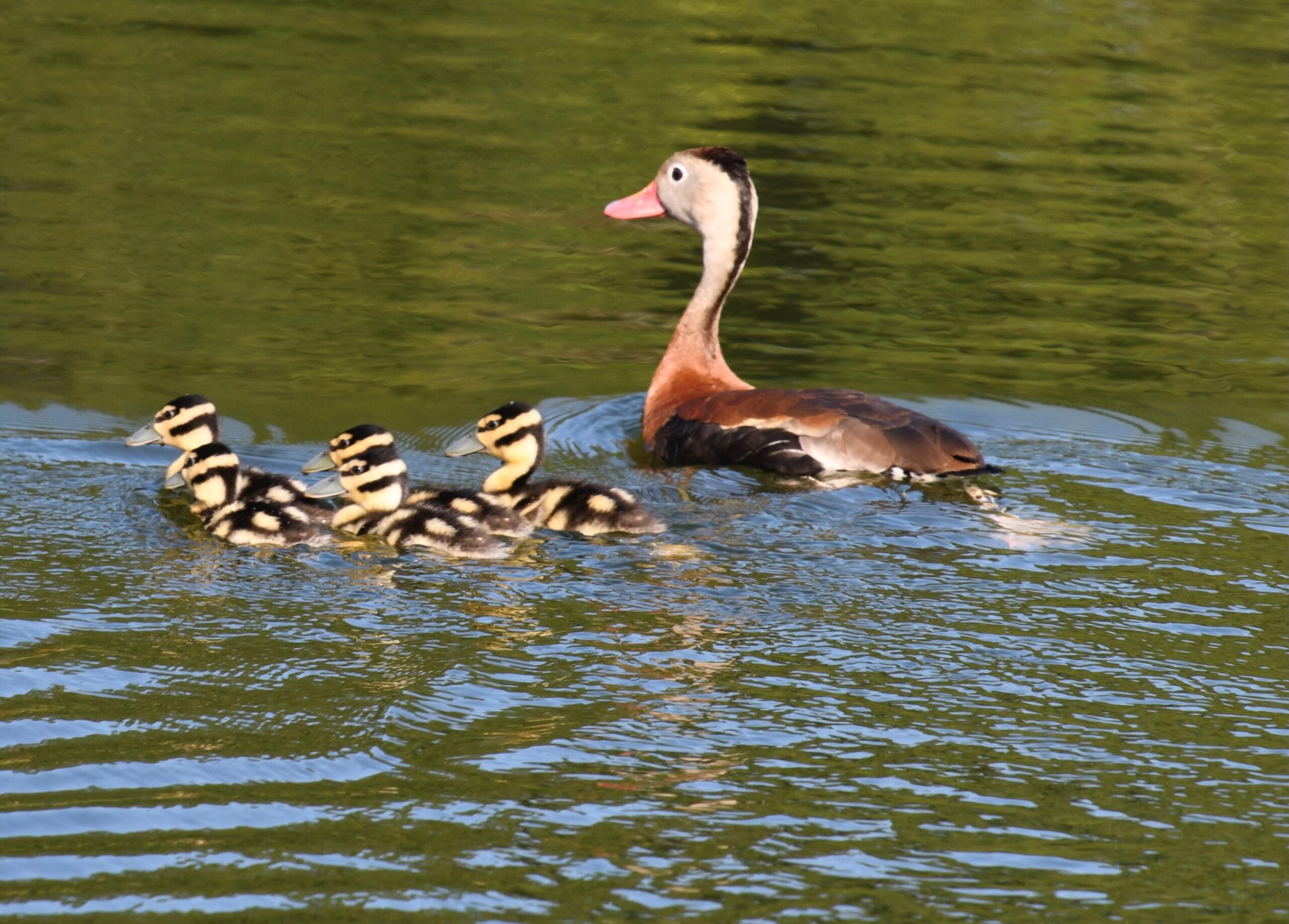
I thought that when I wrote the October Eye to the Sky that I was finished talking about black-bellied whistling-ducks for the year… Boy, was I wrong! The whistling-ducks that used the Conservancy’s cavity nest box were apparently not the only late-nesting pair at Palmetto Bluff. An adult pair with ducklings was spotted multiple times along the Inland Waterway from South Wilson to River Road neighborhood. As the bird flies, or the duck walks, the distance between where this family was seen and where the cavity nest box pair bred is roughly 3.5 miles, so I feel comfortable saying that this is likely a separate pair spending time on the Inland Waterway. This species has become a year-round resident to Beaufort County, and I am curious to see how many we spot during the Christmas Bird Count in December.


October had quite a few fantastic sightings throughout the month. The Sandhill Loop bird walk had two yellow-billed cuckoos moving together through the canopy. This species is already a challenge to find during the breeding season, often being documented only by sound. However, this pair was quite amiable, and everyone in the group was able to have a great view of the pair. Yellow-billed cuckoos might still be seen in early November, but they are leaving fast and should be in their Caribbean and South American wintering grounds by mid-November. Painted buntings also made their last hurrah this month, with two sightings at Palmetto Bluff. One was a female seen at the Conservancy bird feeders in early October. The other was a young male spotted at the end of the Headwaters Nature Trail bird walk when we popped over to the Duck Pond bridge to see what birds were on the move. October is the latest I have personally seen painted buntings, but there is a miniscule population that hunkers down and spends the winter in Beaufort County. If anyone at Palmetto Bluff sees a painted bunting during the winter, definitely let us know!

Near the end of October, we documented the first hermit thrush of the season. I would say that they are the only winter thrush for our area, but the eastern bluebird and the American robin are also in the thrush family… so it is the only one that has thrush in its name! I often find Hermit thrushes in River Road Preserve, dipping into the woods from the edge of the trails or hopping through holly bushes eating berries. This species spends the winter in Beaufort County and, come spring, we may have a chance to hear their enchanting song before they head north to their breeding range. Along with the hermit thrush, a blue-headed vireo was also spotted in River Road Preserve. They are a winter species for Beaufort County, but they can be hard to find. In fact, even though it is not the first one that I have seen, or the first one documented at Palmetto Bluff, I realized that this was actually the first blue-headed vireo that I’ve seen at Palmetto Bluff! While the blue-headed vireo is a unique sighting, the next species is a dime a dozen.


The yellow-rumped warblers arrived in October, but they were slightly late compared to their normal mid-month arrival. This delay could have been due to a cold or warm front, strong headwinds, or even an abundance of food further north causing them to spend more time fattening up for the next leg of their journey. Butter butts, fondly named due to the yellow patch on their rump, can be seen around Beaufort County in large flocks during the winter. Their abundance has garnered the indifference, and sometimes ire, of some bird watchers as yellow-rumps are capable of being one of the most observed birds on your morning outings. Similar to how I try to show appreciation for the common species, I try to remind myself that butter butts need love too! They are quite adorable, but also their abundance should be seen as a good thing, because that means their populations is doing well, unlike most of the other warblers in North America. Though I will admit it does become trying when they make up most of your bird sightings in the winter.


Black-and-white warblers and palm warblers were two more warbler species seen regularly in October. Black-and-white warblers are not always the easiest to find, though we had a surprisingly good amount of them bouncing around the trees this fall. I’m not sure if this was a case of being in the right place at the right time, individuals still heading south, or if they had a good nesting season and are slightly more abundant this fall. Regardless, I love watching these striking warblers hop along the underside of tree branches like nuthatches. It is adorable! Palm warblers
overwinter in Beaufort County, but I tend to see them most often during the fall and spring migration. Their winter plumage is fairly drab with the underside of their tail having a splash of yellow. They are also known for pumping their tail, which is a great identifying feature to look for as they move along the ground.
The last bird that I want to mention seen in October is another warbler species, but this individual brought Palmetto Bluff’s species count to 214! Montage naturalist, Brian Byrne, was watching a handful of ruby-crowned kinglets bounce among a patch of dog fennel when out popped a Wilson’s warbler! This species is rare in the southeast, but their yellow head and black cap is unmistakable. I have not seen a Wilson’s warbler since I lived in Oregon in 2016, so I am a little jealous of this sighting, but I am incredibly excited for the new addition to Palmetto Bluff’s bird list.
November is when we see a sharp decline in activity as the fall migration ends. Most species have already arrived at their wintering grounds, but some stragglers are still passing through. American redstarts and Cape May warblers might still be seen in November, but not for long. We certainly want to keep our eyes to the sky this month as we may have a chance to see sandhill cranes or American white pelicans fly overhead. Sandhill cranes are normally seen late in the migration, even as late as mid-December, and we mainly see them in flight as they head towards Florida. In contrast, American white pelicans have slowly started to become an overwintering species in Beaufort County. While they are rarely seen alone, one was reported in the Inland Waterway years ago by Charlie Bales, a former Conservancy and Union Camp employee. Most of my white pelican sightings have not been at Palmetto bluff and quite a few of them were of birds on the wing. However, Fish Haul Beach and the Savannah National Wildlife Refuge have been good places in my experience to find them resting or swimming.


Cedar waxwings will begin to appear in November. While this species forms large flocks in the winter, some people can go through the entire season without documenting any cedar waxwings. This lack of observations can likely be linked to our ability to hear them. Cedar waxwing calls lie within 6 and 8 kilohertz, which is near the upper limit of typical human conversation. While young people with excellent hearing can hear up to 20 kilohertz, people of all ages without any hearing impairments should be able to hear up to 8 kilohertz and therefore hear cedar waxwings. Unfortunately, many of us suffer from hearing loss throughout our lives that eventually decreases our ability to hear cedar waxwings and other songbirds with high-pitched calls and songs. I am relieved that their vocalizations have not yet left my realm of hearing, but I have not been the most protective of my hearing and I know one day they will. Thankfully, even when I stop hearing them, I know how to draw them to my yard so I can still appreciate their beauty!
Cedar waxwings are one of the most frugivorous species of birds in North America, with their winter diet being close to one hundred percent fruit. Knowing this, we can include native berry-producing plants to our gardens and increase our chances of having these stunning birds pay us a visit. Native hollies such as American holly, yaupon holly, and winterberry holly are great berry producing plants that have ripe fruit from October through the winter. Holly species come in a variety of sizes and some of them do great as box or privacy hedging. Another species to use, if they can fit in the yard, is eastern red cedars. Cedars produce tons of small fruit in the fall and are an excellent food source for waxwings. This maritime forest tree species not only provides evergreen foliage, but it is also the cedar waxwing’s namesake!
The aforementioned plants are great ways to attract cedar waxwings, which is fantastic because our bird feeders are not attractive to waxwings. In contrast, purple finches, goldfinches, and other boreal species arriving in the winter are granivores, which gives one reason to monitor your bird feeders more closely. The second reason is because November is the starting month for the winter-long project called FeederWatch. FeederWatch is a citizen science effort created by the Cornell Lab of Ornithology where anyone can participate. From mid-November until the end of April, participants are asked to watch their bird feeders for two consecutive days a week for a minimum of 15 minutes each time. This dataset is then submitted to FeederWatch where it is accumulated along with everyone else’s sightings. This information helps create a big picture of where winter birds are located and in what abundance. This big picture is important as it can help detect potential changes in the wintering ranges of these species. This winter will be the 4th
year that the Conservancy has participated. If you do not wish to participate on your own, you can join us as we monitor the Conservancy bird feeders for FeederWatch!
Things are beginning to quiet down as the migration comes to a close, but there may still be some surprise visitors! If you see or photograph something you wish to share, you can submit your sightings to Aaron Palmieri at apalmieri@pbconservancy.org and they may appear in next month’s update.
October’s Unique Sightings:
October Contributors:
Pat Cole, David Miller, Janet Bender, Brian Byrne