The art in Palmetto Bluff’s River House includes dozens of different interpretations of the Lowcountry landscape: there are live oaks painted in oil and ferns drawn in watercolors. There are reeds sculpted in iron and waves etched in glass. But only one of the featured artists, Savannah photographer Jack Leigh, found his inspiration in the people working in the tidal estuaries. Leigh’s black and white images of oystermen on the rivers of South Carolina are aesthetic tributes to a vanishing Southern tradition.
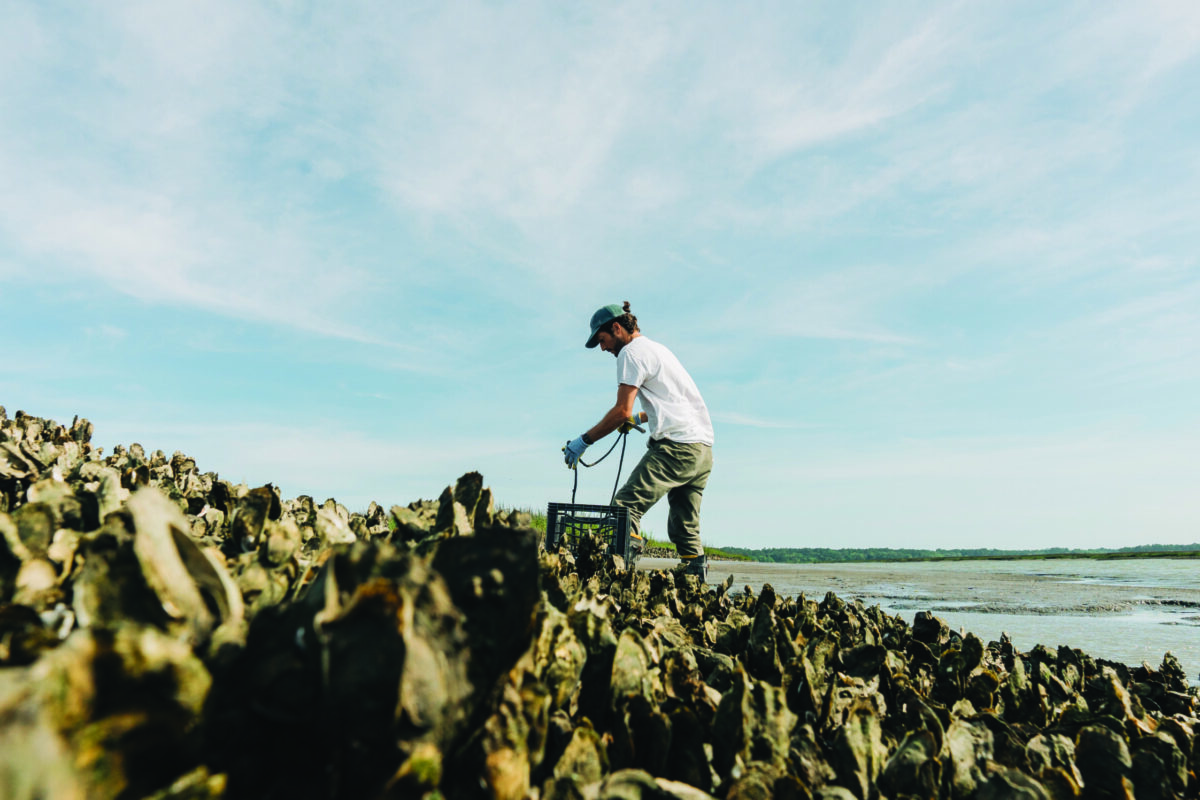
The prints in the River House are from Leigh’s book Oystering: A Way of Life and are his photographic documentation of the 1970s, when scores of oystermen plied the waterways each day in their “bateaux,” which are wide, flat bottom boats, built to carry oysters. An oysterman’s day began at dawn and, depending on the tides, could continue well into the night, when a fire in a bucket provided the only light (see right). It was a solitary task, as each oysterman worked a different oyster bed and each man kept the whereabouts of his best sites a closely guarded secret. Throughout the day, when the boats were filled with oysters, the men would return to the shore and unload at the shucking house. Inside the house, women worked by hand, cracking the shells open one by one, removing the meat and canning the oysters. Although Leigh was well aware that he was recording a way of life that was disappearing, he could not have known how rapidly it would fade into history. Four decades later, the Bluffton Oyster Company is the last hand-shucking operation in South Carolina.%GALLERY%Part of the reason that Leigh’s images are so striking is that it is clear that the people being photographed trusted the photographer. Leigh made sure that people were comfortable sharing their lives with him. “Jack had a true love for this land and spent his time creating connections with the disappearing lifestyles you find here,” says Susan Laney, Director of the Jack Leigh Estate and co-curator of the recent exhibition on Leigh called Full Circle at the Savannah College of Art and Design’s Museum of Art. Jack donated an entire collection of documents and personal files Leigh donated to the University of Georgia’s Hargrett Rare Book and Manuscript Library shortly before he died, and Susan helps to keep his works alive.
“When I went to the collection, I found hundreds, and I mean hundreds, of tenderly crafted letters he sent to each person he photographed – always searching for more leads and thanking people for letting him into their homes and lives. Leigh had these long, warm correspondences with so many of his subjects. It was these connections that allowed him, an outsider, to be welcomed into all these small, insular communities.”
Leigh’s appreciation of his subjects’ generosity is apparent in his writing as well as his photos. His description of photographing an oysterman is as evocative as his stunning images: “I spent two seasons on the creeks and rivers, photographing men and women working to the rhythm of the tides rather than the clock. There was one morning that I remember best of all. My boat was packed with supplies and cameras. It was still, before the light, and the fog was thick and dream-like . . . A vague marsh line appeared and I headed there. As I moved closer, an oblique, lone figure materialized upon the mud-flat, his bateau beside him. He worked peacefully. I made my way to him, running aground many times until I found water deep enough to go through. When I finally got to the edge of the mud-flat, I got out of my boat, anchored it, and began my unsteady half-buried walk toward him. He continued to work, as he had for all his life. I felt then I was walking toward the heart of this life: toward the man who possessed an untellable secret, deeply at home in himself and his own way of life.” Jack Leigh, Oystering: A Way of Life.
If you take a moment to examine Leigh’s photos on the wall of the River House lounge area, you’ll find yourself drawn to the people in his images. This is exactly what Leigh intended and he used subtleties in composition to ensure our attention was where it should be. Compared to the plein air paintings, where the backgrounds are full of clouds, Leigh’s photos seem stark. The mists that rose off the warm waters in those early morning shoots are the frequent backdrop for Leigh’s images.
In the photo, Heading Out for example, an oysterman sets off into the fog, a background almost completely white. The oysterman and his boat are dark shapes that stand out in contrast, and by creating a triangle of the oysterman and the boat, Leigh makes the viewer’s eye move toward the front of the boat. This movement of the viewer’s eye to the oysterman in the bow simulates the movement of the boat. In fact, it is easy to imagine that the photo is a video, and your eyes press play to watch the boat move forward into the fog. Many of Leigh’s images convey a similar sense of action and seem to demonstrate, rather than simply record, a way of life.
Leigh, who died in 2004, is best known for Midnight, his photo of the Bird Girl Statue in Bonaventure Cemetery that was selected as the cover for the best-seller, Midnight in the Garden of Good and Evil. The iconic photo of an inanimate object has inspired scores of tourists to descend on Savannah in search of the statue, but it lies in stark contrast to the prints of a vanishing way of life that are on display in the River House bar area. Stop by and look at the Leigh’s photos on oystering. They are the vision of a remarkable man who set out to preserve the cultural history of the Lowcountry through photographs of her people.