Written by Palmetto Bluff
Nov 29, 2022
Description
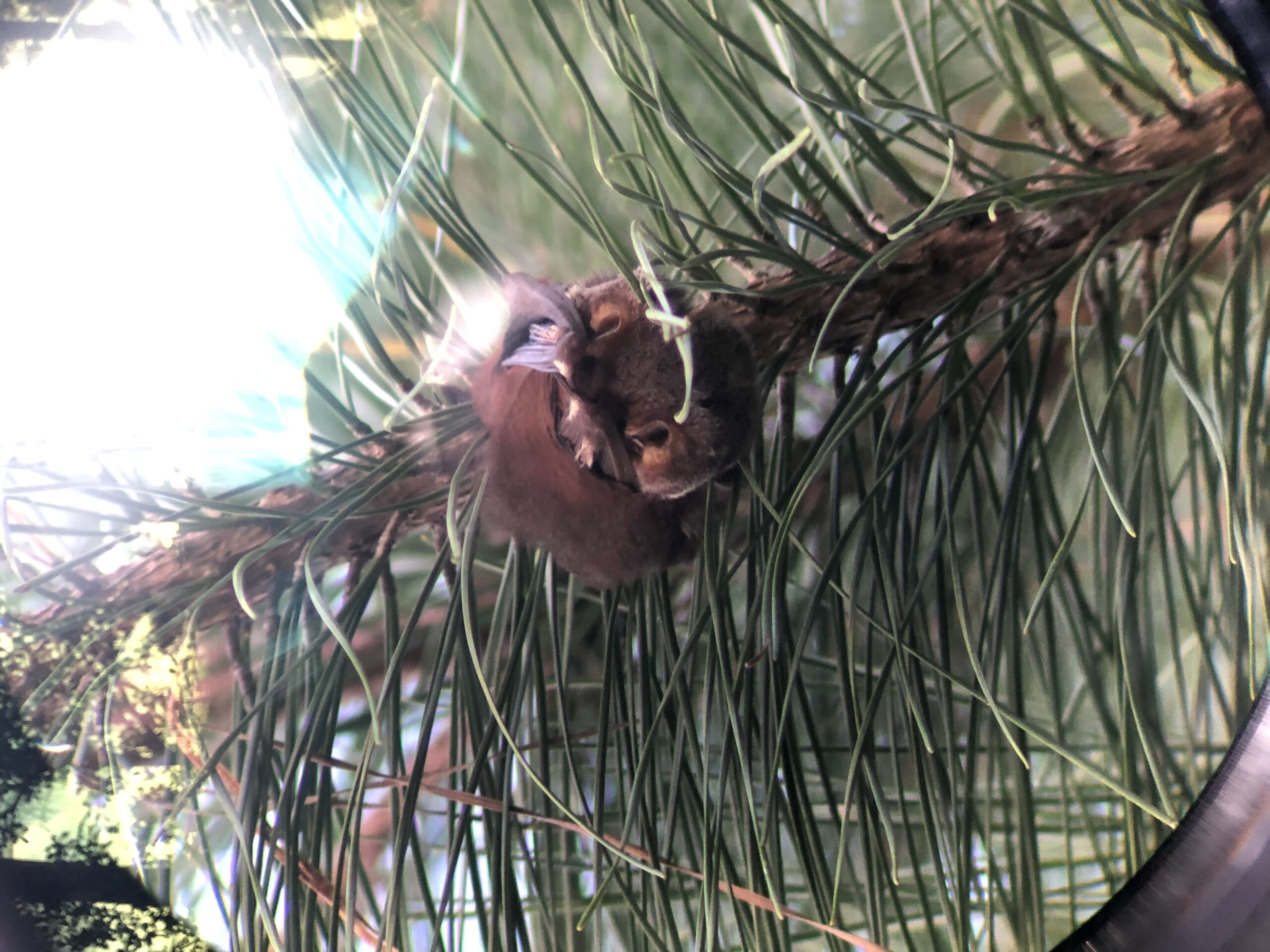
Seminole bats (Lasiurus seminolus) are a medium-sized bat, measuring around 4.5 inches from head to tail with a wingspan of approximately 12 inches. They weigh between 8-15 g with females a little larger than males. This is about the same as a single AAA battery! Other species in South Carolina range from 5 g to 35 g, putting the size of Seminole bats somewhere in the middle. Seminole bats are in the genus Lasiurus, which is known as the hairy-tailed bats. Bats in this group have tail membranes that are mostly or completely furred, unlike other bats in South Carolina which have tail membranes without fur. The fur of Seminole bats is deep mahogany, with frosted tips on the back and white patches on the shoulders.

Similar Species
Seminole bats can be confused with the eastern red bat (Lasiurus borealis). Red bats are in the same genus, but their fur is more of a bright red color compared to the Seminole’s dark mahogany. I was taught that Seminole bats look like a red bat with a “muddy” face due to a dark patch across their faces that red bats do not have. Even with our experience handling these bats, we do occasionally get an individual that is difficult to identify because of how similar they can look.

Range
The range of the Seminole bat spreads across the southeastern United States, from the Atlantic coastal plain, to eastern Texas and Oklahoma, and north into central Missouri and Kentucky. The range has been expanding northward over the last 50 years due to climate change and major land use changes. Stray individuals have been found as far north as southern Wisconsin, New York, and Ohio.

Roosting Habitat
This species is often associated with maritime forests that contain large amounts of Spanish moss. While they are found in these forests, Seminole bats can also be found in many mixed oak, pine, and hickory forests across their range. They tend to roost in the open foliage of tall pine trees or occasionally in Spanish moss in the warmer months, and can be found roosting in leaf litter when temperatures drop below freezing. Roosting openly in foliage is common for bats in the genus Lasiurus. However, other bat species in South Carolina roost in hollow trees, underneath peeling bark, in caves, or even in culverts under the interstate!

Beginning in the fall of 2020, we have been tracking Seminole bats at Palmetto Bluff to their daytime roosts in fall and summer to see what kind of roosts they use. All the Seminole bats in our study roosted in the open on small branches or pinecones. This differs from winter studies in other parts of South Carolina where they were occasionally recorded roosting within pine needles on or near the forest floor. While tracking Seminole bats in summer of 2021, we tracked each bat to either the canopy of a loblolly or slash pine tree, with the exception of one male that roosted solely in hickory trees. In the summer of 2022, we found two females roosting with their pups in oak trees, showing us that they use more tree species than we documented in the first summer.
Echolocation
All bat species in the United States use echolocation to navigate through the night. Bats continuously produce high frequency sound waves while they fly to “see” the environment around them. These sound waves bounce off objects and return to the bat, so they can avoid obstacles and catch prey. Each species has unique characteristics of their echolocation that can be translated to a form that we can see and hear, called a sonogram. Researchers record bat calls with a specialized microphone and transform the soundwaves into visual sonograms for analysis. They can then identify which species are present and which are absent in a certain area. The echolocation calls of Seminole bats are in the 30-35 kHz range, approximately 10-15 kHz higher than humans can hear. We are lucky that we cannot hear their calls because some bats have a call so loud it is equivalent to holding a smoke detector next to your ear as it goes off!

Diet
Seminole bats consume a wide variety of flying insects, including leafhoppers, moths, flies, beetles, bees, and ants. They catch these insects in flight while foraging in forest corridors, over open water, along treetops, and along forest edges. Seminole bats, like all bats in South Carolina, play a major role in pest control by consuming large amounts of these insects every night. Throughout the United States, bats provide farmers a free pesticide service that has an estimated value of approximately $23 billion annually. This number does not include the cost of mitigating negative effects that all these extra pesticides would have on the environment if they had to be used.
Reproduction
Like many bats in temperate areas, Seminole bats mate in the fall and give birth in late spring or early summer, but the gestation period does not last all winter. If you do not think that this adds up, you would be correct. This is because females store sperm over the winter and become pregnant in the spring. This is known as delayed fertilization. The sperm is stored in the uterine tract until it is released to fertilize the egg.
A female Seminole bat can give birth to one to four pups in spring, though having only one or two is thought to be more common. When there is only a single pup, the pup can be up to a third of the mom’s body weight at birth. Though, when there are multiple pups, each pup is not quite a third of the mom’s weight. We originally thought that more than two pups seemed impossible until we found a female roosting with three healthy pups here at Palmetto Bluff!
Females tend to roost in the warmest places on a tree while raising young to aid in the early development of their offspring. Newborn bats cannot thermoregulate, so they put energy towards rapid growth instead of putting energy towards producing body heat. Since Seminole bats do not raise their young in large colonies like other species, the pup gets heat through solar exposure instead of body heat from a colony. After about a month the pups begin to fly on their own and start becoming independent of the mother. They may continue to roost with the mother for a while even after learning to fly and forage on their own.
Predation
Some of the major predators for Seminole bats (and most bats) are owls, hawks, snakes, raccoons, and opossums. Blue jays, striped skunks, and house cats have also been documented preying on Seminole bats. This is another great reason to keep your cats indoors!
The Conservancy Research Fellowship, and much of the research on Seminole bats, is graciously funded through the Friends of the Palmetto Bluff Conservancy.